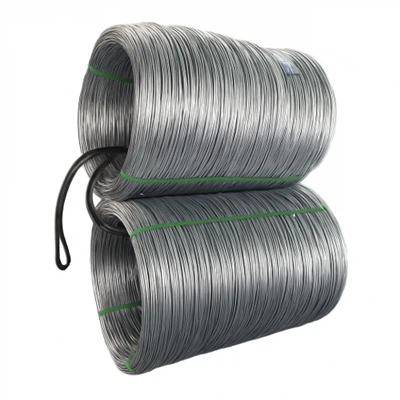
Hey there! As a supplier of 420 stainless steel wire, I often get asked about how it stacks up against 430 stainless steel wire. So, let's dive right into it and compare these two types of stainless - steel wires.


Composition
First off, let's talk about the composition. 420 stainless steel wire is a martensitic stainless steel. It contains around 12 - 14% chromium and up to 0.3% carbon. This relatively high carbon content gives it the ability to be heat - treated, which can significantly increase its hardness and strength.
On the other hand, 430 stainless steel wire is a ferritic stainless steel. It has a chromium content of about 16 - 18% and a very low carbon content, usually less than 0.12%. The low carbon content makes it less hardenable by heat treatment compared to 420.
Physical Properties
Hardness and Strength
420 stainless steel wire can be heat - treated to achieve high hardness levels. After heat treatment, it can have a Rockwell hardness of up to 50 - 55 HRC, which makes it suitable for applications where high wear resistance is required, like in cutlery and surgical instruments.
In contrast, 430 stainless steel wire is much softer. Its hardness typically ranges from 80 - 90 HRB. While it's not as hard as 420, it still has decent strength and is more formable.
Corrosion Resistance
430 stainless steel has good general corrosion resistance, especially in mild environments. The higher chromium content in 430 helps in forming a passive oxide layer on the surface, which protects it from corrosion. However, in more aggressive environments, like those with high chloride concentrations, 430 may be prone to pitting and crevice corrosion.
420 stainless steel, although it has a lower chromium content, can have good corrosion resistance when properly heat - treated and passivated. But it's still not as corrosion - resistant as 430 in non - heat - treated conditions. In fact, in some cases, if 420 is not heat - treated correctly, it may be more susceptible to corrosion than 430.
Applications
420 Stainless Steel Wire
Due to its high hardness and wear resistance, 420 stainless steel wire is commonly used in applications such as:
- Cutlery: Knives made from 420 stainless steel can hold a sharp edge for a long time.
- Surgical Instruments: Its hardness and ability to be sterilized make it suitable for medical tools.
- Springs: In some cases, where high strength and hardness are required for springs, 420 wire can be used. You can check out more about different types of stainless - steel wires, like 304L Stainless Steel Wire and 304 Stainless Steel Spring Wire on our website.
430 Stainless Steel Wire
430 stainless steel wire is often used in:
- Kitchen Appliances: Its good corrosion resistance and formability make it ideal for items like refrigerator liners, oven racks, and dishwasher components.
- Automotive Trim: It can be used for exterior automotive trim due to its aesthetic appeal and corrosion resistance.
- Architectural Applications: For things like handrails and decorative elements in buildings.
Cost
Cost is also an important factor when comparing these two types of wires. Generally, 420 stainless steel wire is more expensive than 430. The higher carbon content and the ability to be heat - treated add to its production cost. 430, with its lower carbon content and simpler production process, is more cost - effective for applications where high hardness is not a primary requirement.
Manufacturing Process
The manufacturing process for 420 and 430 stainless steel wires also differs. 420 stainless steel wire needs to go through a heat - treatment process to achieve its desired hardness and properties. This involves heating the wire to a specific temperature and then quenching it. The heat - treatment process needs to be carefully controlled to avoid issues like cracking or uneven hardness.
430 stainless steel wire, on the other hand, doesn't require heat treatment for most applications. It can be cold - worked to increase its strength and formability. Cold - working involves processes like drawing the wire through a die to reduce its diameter and increase its length.
Weldability
Weldability is another aspect to consider. 430 stainless steel wire has relatively good weldability. It can be welded using common welding methods like TIG (Tungsten Inert Gas) welding and MIG (Metal Inert Gas) welding. However, care must be taken to prevent the formation of chromium carbides, which can reduce the corrosion resistance of the welded area.
420 stainless steel wire is more difficult to weld. The high carbon content can lead to the formation of hard and brittle martensite during welding, which can cause cracking. Special welding procedures and pre - and post - weld heat treatments are often required to ensure a successful weld.
Surface Finish
430 stainless steel wire can have a smooth and shiny surface finish, which makes it aesthetically pleasing for applications where appearance matters. It can be polished to a high gloss finish.
420 stainless steel wire can also be polished, but its surface finish may be more prone to scratches due to its higher hardness. However, in some applications, a slightly rougher surface may be acceptable or even desired, such as in cutlery where it can help with grip.
Availability
430 stainless steel wire is more widely available in the market. It is a common choice for many general - purpose applications, so it can be found in a variety of sizes and forms.
420 stainless steel wire, while also available, may be more limited in terms of the sizes and quantities that are readily available. This is because its production is more specialized and it is used in more niche applications.
If you're in the market for 420 stainless steel wire, I'd love to talk to you about your specific needs. Whether you're looking for a particular size, quantity, or have some special requirements, I'm here to help. You can check out our 420 - stainless Steel Wire page on our website for more information. We're always open to discussing your project and providing you with the best solutions.
References
- ASM Handbook Volume 1: Properties and Selection: Irons, Steels, and High - Performance Alloys
- Stainless Steel World magazine articles on stainless - steel wire properties and applications