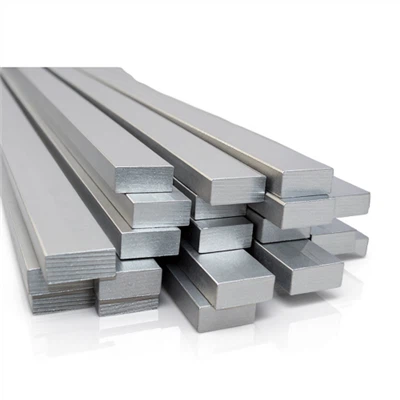
304 stainless steel belongs to the austenitic family of stainless steels, with a core composition of 18% chromium (Cr) and 8% nickel (Ni), with small amounts of carbon, manganese and other elements. This alloy ratio gives it a unique performance: chromium forms a dense oxide film on the surface, which can resist the erosion of the atmosphere, fresh water, weak acids and alkalis and other media, and is suitable for wet or mildly corrosive environments. Stable mechanical properties can be maintained below 800°C, and short-term temperature resistance can reach 900°C, suitable for high-temperature operating scenarios. Austenitic structure makes it easy to cut, weld, bend and press moulding to meet the demand of complex process.
Non-magnetic or weakly magnetic, slight magnetism may occur after cold working, and it meets the standard of food-grade material for direct contact with food or pharmaceutical products.
Flat steel, as one of its common forms, has a rectangular cross-section with a thickness usually ranging from 3-20mm and a width of 20-200mm, combining the load-bearing capacity of plate with the flexibility of profiles, which can be customised with different sizes and surface treatments such as brushed, polished and sandblasted.
Product Parameter (Specification)
Products description:
|
Product information |
Parameter |
Product intormation |
Parameter |
|
Product name |
Stainless steel flat bar |
Standard |
ASTM, JIS, DIN, EN |
|
Length |
Customised to customer requirements |
Certification |
ISO, SGS |
|
Grade-ASTM |
201, 202, 302, 304, 304L, 310, 310S, 316, 316L, 321, 410, 431, 430F, 904L & other |
Price term |
FOB,CIF |
|
Technique |
Cold rolled hot rolled |
Payment terms |
T/T L/C |
|
Packaging and delivery |
|||
|
Note : bundle, plastic bags, thin film, wooden pallet, standard seaworthy export packing or as customer demands |
|||
Product Feature and Application
Architectural and decorative works
In the field of construction, 304 stainless steel flat steel is often used in scenes where load-bearing structure and aesthetic design are combined. For example, as a staircase handrail, door and window frames or curtain wall keel support, its high strength and rust resistance can withstand weather erosion for a long time, at the same time, flat steel regular cross-section is easy to hide the installation of structures to enhance the overall aesthetics of the building. In the interior decoration, the flat steel after drawing or mirror polishing can be used as skirting, wall dividers or furniture edging, giving the space a modern industrial style.
01
Mechanical manufacturing and equipment processing
In industrial equipment, 304 stainless steel flat steel is ideal for manufacturing brackets, rails, connectors. For example, automated production lines in the conveyor belt support frame needs both rigidity and resistance to mild corrosion, flat steel rectangular cross-section can be dispersed load-bearing pressure; precision instruments or medical equipment, the internal structure of the components rely on its non-magnetic properties, to avoid electromagnetic interference. In addition, flat steel easy to weld and cut characteristics, can be quickly processed into shaped parts, reducing production costs.
02
Energy chemical and environmental protection facilities
In the chemical industry, 304 stainless steel flat steel is used in mildly corrosive environments for pipeline support frames, valve assemblies, or reaction tank reinforcement structures, and its acid and alkali resistance extends equipment life. New energy fields such as solar energy bracket, sewage treatment equipment frame, flat steel in the outdoor humidity or temperature difference in the environment can still maintain the stability of the structure, reduce the frequency of maintenance.
03
Transport and home life
The interior skeleton of rail vehicles, ship deck railings often use 304 stainless steel flat steel, its lightweight features help reduce the overall weight, while resisting salt spray and humid environment. In the home, from the metal frame of custom cabinets to the support structure of outdoor garden tables and chairs, the durability of flat steel and the diversity of surface treatments (such as matte, coloured coating) to balance function and design to meet individual needs.
04
Emerging innovative applications
With the development of technology, 304 stainless steel flat steel in the 3D printing substrate, smart home electronics shell and other emerging areas. For example, its thermal conductivity and rigidity is suitable for use as a thermal support for electronic components; in art installations or public sculpture, flat steel can be bent, hollowed out and other processes to achieve creative modelling, showing the value of industrial aesthetics.
05
Production Details
1.Material composition (ASTM A276 standard)
Major Elements:
|
Element |
Chromium (Cr) |
Nickel (Ni) |
Carbon (C) |
Manganese (Mn) |
silicon (Si) |
sulfur (S) |
phosphorus (P) |
|
Content(%) |
18 - 20 |
8- 10.5 |
MAX 0.08 |
MAX 2.0 |
MAX 1.0 |
MAX 0.045 |
MAX 0.03 |
2.Mechanical properties
|
Condition |
Tensile strength (MPa) |
Yield strength (MPa) |
Elongation (%) |
Hardness (HB) |
|
Data |
≥515 |
≥205 |
≥40 |
≤201 |
3.Physical properties
|
Condition |
Density |
Melting point |
Thermal conductivity |
Resistivity |
|
Data |
7.93 g/cm³ |
1400-1450°C |
16.2 W/m-K (at 100℃) |
0.72 Ω-m |
4.Product specifications and forms
|
Item |
Parameter range |
Description |
|
Material grade |
304 (06Cr19Ni10) |
Conformity standard: GB/T 1220-2007 (national standard), ASTM A240/A240M (American standard). |
|
Cross-section shape |
Rectangle |
Thickness and width of the combination of different specifications, edges can be right-angled or rounded processing |
|
Thickness (mm) |
3 ~ 20 |
Common thickness: 3, 5, 6, 8, 10, 12, 15, 20 (can be customised non-standard size) |
|
Width (mm) |
20 ~ 200 |
Common width: 20, 30, 40, 50, 60, 80, 100, 120, 150, 200 (on request) |
|
Length (m) |
1 ~ 6 |
Commonly specified size is 6 metres, support section cutting or special length customisation |
|
Surface condition |
2B, BA, No.4, brushed, sandblasted, etc. |
2B (cold rolled bright), BA (mirror), No.4 (brushed) is commonly used in industry, and the decorative scene can be polished or colour-plated treatment. |
FAQ
Packaging Display

Hot Tags: 304 stainless steel flat bar, China 304 stainless steel flat bar manufacturers, suppliers, factory