As a seasoned supplier of Steel Solid Angle Bar, I've encountered numerous inquiries regarding the technical properties of our products. One question that often surfaces is, "What is the Poisson's ratio of a steel solid angle bar?" In this blog post, I'll delve into the concept of Poisson's ratio, its significance for steel solid angle bars, and how it impacts the performance of these essential construction materials.
Understanding Poisson's Ratio
Poisson's ratio is a fundamental mechanical property that describes the relationship between the lateral strain and the longitudinal strain of a material when it is subjected to an axial load. In simpler terms, when you pull or compress a material in one direction, it will not only deform in that direction but also in the perpendicular directions. Poisson's ratio, denoted by the Greek letter ν (nu), is defined as the negative ratio of the transverse strain (ε_transverse) to the axial strain (ε_axial):
ν = - ε_transverse / ε_axial
For most materials, Poisson's ratio ranges between 0 and 0.5. A value of 0 indicates that the material does not deform laterally when subjected to an axial load, while a value of 0.5 implies that the material is incompressible. In the case of steel, Poisson's ratio typically falls within the range of 0.25 to 0.33.
Poisson's Ratio in Steel Solid Angle Bars
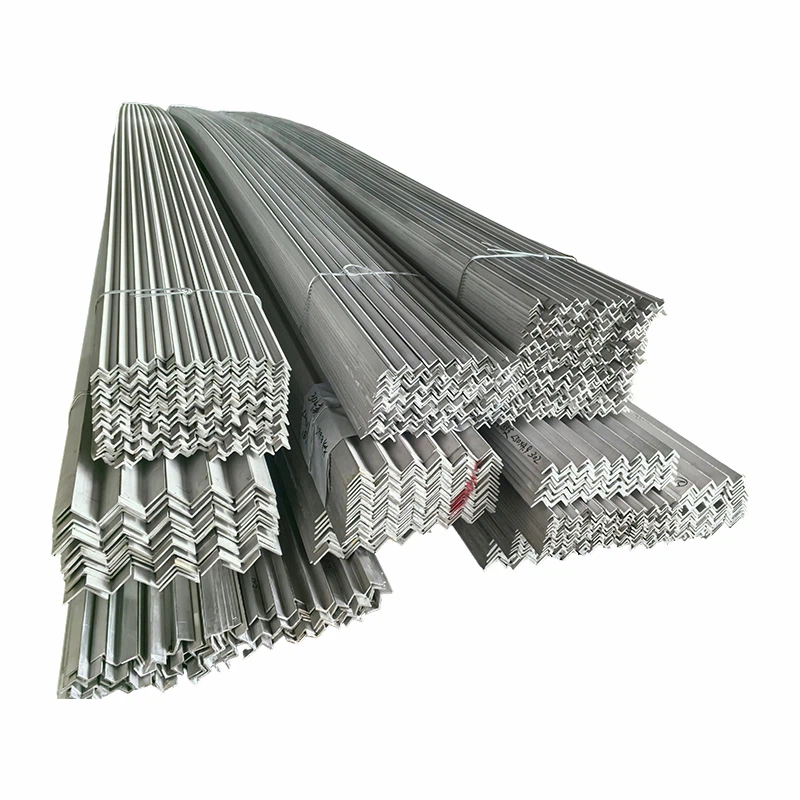
Steel solid angle bars are widely used in construction, engineering, and manufacturing applications due to their high strength, durability, and versatility. These bars are typically made from various grades of steel, including Stainless Steel 304 Angle Bar and Standard Angle Bar, each with its own unique mechanical properties.
The Poisson's ratio of a steel solid angle bar plays a crucial role in determining its behavior under load. When an angle bar is subjected to an axial load, such as tension or compression, it will experience both longitudinal and lateral deformation. The lateral deformation, which is governed by Poisson's ratio, can have a significant impact on the overall stability and performance of the structure.
For example, in a structural application where a steel solid angle bar is used as a beam or a column, the lateral deformation caused by Poisson's ratio can affect the alignment and integrity of the structure. Excessive lateral deformation can lead to buckling, bending, or even failure of the angle bar, compromising the safety and functionality of the entire structure.
Factors Affecting Poisson's Ratio in Steel
The Poisson's ratio of steel can be influenced by several factors, including the chemical composition, microstructure, and manufacturing process of the material. Here are some key factors that can affect Poisson's ratio in steel solid angle bars:
- Chemical Composition: The chemical composition of steel, including the percentage of carbon, manganese, silicon, and other alloying elements, can have a significant impact on its mechanical properties, including Poisson's ratio. For example, steels with higher carbon content tend to have lower Poisson's ratios, while steels with higher alloying element content may have higher Poisson's ratios.
- Microstructure: The microstructure of steel, which refers to the arrangement and distribution of its grains and phases, can also affect its Poisson's ratio. Steels with a fine-grained microstructure generally have higher Poisson's ratios compared to steels with a coarse-grained microstructure.
- Manufacturing Process: The manufacturing process used to produce steel solid angle bars, such as hot rolling, cold rolling, or forging, can also influence their Poisson's ratio. Hot-rolled steel angle bars typically have a more uniform microstructure and a lower Poisson's ratio compared to cold-rolled or forged angle bars.
Importance of Poisson's Ratio in Design and Engineering
In design and engineering applications, it is essential to consider the Poisson's ratio of steel solid angle bars to ensure the safety and performance of the structure. Engineers and designers use Poisson's ratio to calculate the lateral deformation, stress distribution, and stability of angle bars under various loading conditions.
By accurately accounting for Poisson's ratio, engineers can optimize the design of steel solid angle bars to minimize lateral deformation, prevent buckling and bending, and ensure the long-term durability and reliability of the structure. This can help to reduce the risk of structural failure, improve the overall efficiency of the construction process, and save costs in the long run.
Conclusion
In conclusion, Poisson's ratio is a critical mechanical property that plays a significant role in determining the behavior and performance of steel solid angle bars. As a supplier of high-quality Steel Solid Angle Bar, we understand the importance of providing our customers with accurate information about the technical properties of our products.
By considering the Poisson's ratio of steel solid angle bars in design and engineering applications, engineers and designers can ensure the safety, stability, and performance of the structures they build. Whether you're working on a small-scale construction project or a large-scale industrial application, our team of experts is here to help you select the right steel solid angle bar for your needs.
If you have any questions or need further information about Poisson's ratio or our range of steel solid angle bars, please don't hesitate to contact us. We're committed to providing our customers with the highest level of service and support, and we look forward to working with you on your next project.

References
- Callister, W. D., & Rethwisch, D. G. (2017). Materials Science and Engineering: An Introduction. Wiley.
- Ashby, M. F., & Jones, D. R. H. (2012). Engineering Materials 1: An Introduction to Properties, Applications, and Design. Butterworth-Heinemann.
- Budynas, R. G., & Nisbett, J. K. (2011). Shigley's Mechanical Engineering Design. McGraw-Hill.