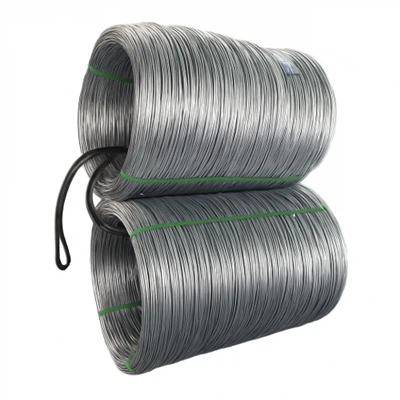
Hey there! As a supplier of 410 stainless steel wire, I've gotten a ton of questions about internal stress in this type of wire. So, I thought I'd sit down and write this blog to share what I know.
First off, let's talk about what internal stress actually is. Internal stress, also known as residual stress, is the stress that remains in a material after the original cause of the stress has been removed. In the case of 410 stainless steel wire, these stresses can come from a bunch of different processes during manufacturing.


One of the main sources of internal stress in 410 stainless steel wire is the cold - drawing process. Cold drawing is a common method used to reduce the diameter of the wire and improve its surface finish and mechanical properties. When we pull the wire through a die at room temperature, the outer layers of the wire experience more deformation than the inner layers. This uneven deformation creates internal stresses. The outer layers are in a state of residual compressive stress, while the inner layers are in a state of residual tensile stress.
Another factor that can introduce internal stress is heat treatment. 410 stainless steel is a martensitic stainless steel, which means it can be hardened by heat treatment. During quenching, a rapid cooling process, the surface of the wire cools much faster than the core. This difference in cooling rates leads to a volume change, and as a result, internal stresses are generated. If the heat treatment isn't carefully controlled, these stresses can be quite significant and may even cause cracking in the wire.
Welding can also cause internal stress in 410 stainless steel wire. When we weld the wire, the high - temperature zone near the weld rapidly heats up and then cools down. This thermal cycle causes the metal to expand and contract unevenly, creating internal stresses in the welded area. These stresses can affect the integrity of the weld and the overall performance of the wire.
Now, you might be wondering why internal stress matters. Well, these stresses can have a big impact on the performance of 410 stainless steel wire. For one thing, they can reduce the fatigue life of the wire. Fatigue failure occurs when a material fails under repeated loading. The internal stresses in the wire can act as stress raisers, making it more likely for cracks to initiate and propagate under cyclic loading.
Internal stress can also affect the corrosion resistance of the wire. In a corrosive environment, the areas under tensile stress are more likely to experience corrosion. This is because the tensile stress can cause the metal to be more reactive, making it easier for the corrosive agents to attack the wire.
Moreover, internal stress can lead to dimensional instability. Over time, the wire may change shape as the internal stresses try to relieve themselves. This can be a real problem in applications where precise dimensions are required.
So, how do we deal with internal stress in 410 stainless steel wire? One common method is stress relieving. Stress relieving is a heat treatment process where the wire is heated to a relatively low temperature and held there for a certain period of time. This allows the internal stresses to relax without significantly changing the mechanical properties of the wire.
Another approach is to use shot peening. Shot peening involves bombarding the surface of the wire with small spherical particles. This creates a layer of compressive stress on the surface, which can counteract the tensile stresses and improve the fatigue resistance of the wire.
When comparing 410 stainless steel wire with other types of stainless steel wire, like 316 Stainless Steel Wire, 316L Stainless Steel Wire, and 304 Stainless Steel Wire, the internal stress characteristics can be quite different. 316 and 316L are austenitic stainless steels, which are generally more ductile and have better corrosion resistance than 410. The heat treatment and manufacturing processes for these austenitic steels are also different, resulting in different internal stress distributions. 304 stainless steel is also an austenitic steel, and its internal stress behavior is more similar to 316 and 316L than to 410.
In our experience as a 410 stainless steel wire supplier, we always try to minimize internal stress in the wire we produce. We carefully control the manufacturing processes, including cold drawing, heat treatment, and welding, to ensure that the internal stresses are within acceptable limits. We also offer stress - relieving services to our customers to further improve the quality of the wire.
If you're in the market for 410 stainless steel wire, it's important to consider the internal stress factor. Make sure you choose a supplier who understands these issues and can provide high - quality wire with minimal internal stress. Whether you need the wire for a high - stress application or a simple structural use, the internal stress can have a significant impact on the performance and longevity of the wire.
We're here to help you find the right 410 stainless steel wire for your needs. If you have any questions or want to discuss your specific requirements, feel free to reach out to us. We can provide samples, technical advice, and competitive pricing. Let's work together to get you the best 410 stainless steel wire solution.
References
- ASM Handbook Volume 4: Heat Treating. ASM International.
- Stainless Steel: A Guide to Properties, Processing, and Applications. Butterworth - Heinemann.
- Welding Metallurgy and Weldability of Stainless Steels. John Wiley & Sons.