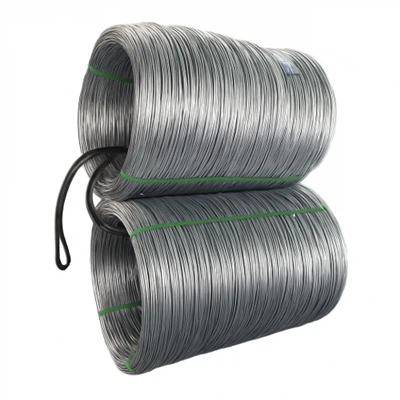
302 stainless steel spring wire belongs to austenitic stainless steel, corresponding to the United States UNS standard S30200, and its executive standards include ASTM A313/A313M-2018 stainless steel spring wire specification for the manufacture of springs of austenitic stainless steel round wire.
Send Inquiry
Description
Send Inquiry
302 stainless steel spring wire belongs to austenitic stainless steel, corresponding to the United States UNS standard S30200, and its executive standards include ASTM A313/A313M-2018 stainless steel spring wire specification for the manufacture of springs of austenitic stainless steel round wire. High modulus of elasticity, excellent abrasion and compression resistance, suitable for high load springs, conventional wire diameter of 0.15mm-12.0mm, support for non-standard customisation (e.g. 0.01-10.0mm), suitable for micro to medium-sized springs. Cold-drawing forming is the main, surface treatment can be selected bright, matte, some products by hydrogen-annealed softening to improve the ductility. Application processes include bending, welding, stamping, etc. Commonly used in precision electronics, automotive industry and other fields. Tension, compression and torsion springs are used at room temperature up to 250°C as aerospace fasteners, corrosion-resistant parts in mechanical engineering and petrochemical equipment. Avoid long-term insulation at 427°C or short-term insulation at 600-870°C to prevent carbide precipitation to reduce corrosion resistance, the need to eliminate residual stress after moulding to reduce the risk of cracking in the chlorine ion environment.
Note : bundle, plastic bags, thin film, wooden pallet, standard seaworthy export packing or as customer demands
1.Mechanical properties
Condition
Tensile strength (MPa)
Elongation (%)
Hardness (HB)
Data
2000-2345
≥40
≤187
2.Physical properties
Condition
Density
Melting point
Thermal conductivity
Resistivity
Data
7.92 g/cm³
1398-1420°C
15-21 W/m-K
720~780nΩ-m
Product Photos
FAQ
Q1:What is the difference between 302 stainless steel and 304 stainless steel spring wire?
Compositional differences: 302 carbon content (C ≤ 0.12%) is slightly higher than 304 (C ≤ 0.08%), higher strength after cold working, but slightly weaker corrosion resistance.
Application scenarios: 302 is suitable for high-strength springs (such as industrial machinery), 304 is more suitable for environments with higher corrosion resistance requirements (such as food-grade equipment).
Q2: How is the corrosion resistance of 302 stainless steel spring wire? Is it suitable for marine environment?
Corrosion resistance: stable to weak acids, alkalis, water vapour and oxidizing media (such as nitric acid), but not resistant to corrosion by chloride ions (such as seawater, salt spray), marine environments are recommended to use 316 stainless steel.
Q3: What is the maximum temperature of 302 stainless steel spring wire?
Short-term temperature resistance: below 750 ° C (such as aviation fuel combustion environment), but the long-term use of temperature is recommended ≤ 250 ° C, to avoid carbide precipitation leading to performance degradation.
Q4: Does 302 spring wire need heat treatment after cold drawing?
Stress relief annealing: It is recommended to hold the temperature at 430-455°C for 0.5 hours and then air-cooled to reduce residual stress and avoid stress corrosion cracking.
Q5: How to avoid material cracking during processing?
Control of cold working rate: the deformation of wire diameter should not be too large (generally ≤ 80%), and intermediate annealing is required for multiple drawing.
Surface lubrication: Use special lubricants to reduce friction damage.
Q6: Can it be welded? Does it affect the performance after welding?
Weldability: poor, welding easily lead to intergranular corrosion, need to use argon arc welding and control the heat input, after welding need to re-solution treatment.
Q7: Do medical springs need special treatment?
Biocompatibility: need to be treated by electrolytic polishing or passivation, and comply with ISO 13485 and other medical device standards.
Q8: What if the spring rusts in a humid environment?
Surface protection: Choose nickel plating or passivation, or change to 316 stainless steel.
Regular maintenance: Apply anti-rust grease after cleaning.
Q9: How to determine the cause of spring failure?
Common failure modes:
Stress corrosion cracking: Cracks on the surface, mostly seen in chloride ion environment.
Fatigue fracture: caused by long-term alternating load, need to optimise the design (such as reducing the working stress).
Q10:What are the specifications of wire diameter? Does it support non-standard customisation?
Conventional range: 0.15mm-12.0mm, support ultra-fine wire (0.01mm) or special cross-section (flat wire, square wire) customisation.
Q11: How to choose the right surface treatment?
Bright surface: High precision instruments (reduce friction).
Matte finish/Hydrogen Retreat: Improve ductility for subsequent bending.
Nickel plating: Enhance conductivity and corrosion resistance.
Q12: Do vendors offer small-lot trial production?
Trial production service: Most vendors support small batch customisation (e.g. from 100m), drawings or technical parameters are required.
Q13:What are the circumstances to be replaced by other materials?
High temperature long-term use: change to 310S stainless steel (temperature resistance 1150°C).
High chlorine environment: change to 316L or Hastelloy.
Hot Tags: 302 stainless steel spring wire, China 302 stainless steel spring wire manufacturers, suppliers, factory